GCC Ho Chi Minh City is becoming an increasingly relevant consideration for multinational companies evaluating where to establish regional capabilities in Southeast Asia.
Global Capability Centres (GCCs) have evolved from primarily transactional support operations into platforms for technology, finance, analytics, engineering, risk, customer operations, research and development, and other specialised functions. As this model matures, the real estate decision behind a GCC becomes more complex.
A company establishing a GCC in Ho Chi Minh City is not simply looking for lower operating costs. It needs access to the right talent, reliable infrastructure, regional connectivity, an environment suitable for collaboration and concentration, and an office that can scale with the organisation.
This makes GCC site selection in Ho Chi Minh City a question of more than office rent. The right location needs to connect the city’s talent and business ecosystem with a workplace capable of supporting the company’s operating model.
From Shared Services to Strategic Capability
The GCC model has progressed significantly from its early shared-services roots.
An early-stage centre may focus on standardised functions such as finance, HR, procurement or customer support. As the centre develops, it can take on more specialised functions including software engineering, data analytics, risk management, professional services and technology operations.
At the strategic end of the spectrum, a GCC can become an innovation and capability platform supporting multiple markets.
Each stage changes the workplace requirement.
Technology and analytics teams require environments that balance focused work with collaboration. Regional leadership teams need high-quality meeting environments. Technology-intensive operations require dependable connectivity, power and building infrastructure. Larger centres need efficient floorplates and the ability to expand without fundamentally disrupting the workplace.
The office therefore becomes part of the GCC operating platform, rather than simply a container for desks.
For companies evaluating a GCC in Ho Chi Minh City, this distinction is particularly important. The building needs to be assessed against the functions the centre will perform today, as well as the capabilities it may absorb in the future.
Why Vietnam Is Entering the GCC Conversation
Vietnam offers several characteristics relevant to GCC site selection: a large and increasingly skilled workforce, a growing technology ecosystem, an established multinational business base and major urban centres capable of supporting specialised functions.
The country’s expanding technology and services sectors have created an increasingly diverse environment for companies establishing regional operations. GCC functions can include software development, engineering, finance, analytics, customer operations, professional services and other knowledge-intensive activities.
However, a country-level assessment is only the starting point.
Talent availability varies by city and discipline. Office supply, commuting patterns, operating costs, infrastructure and access to professional services can also differ substantially between locations.
For this reason, companies evaluating GCC Vietnam should move from a national assessment to a city-level evaluation.
The relevant question is not simply whether Vietnam can support a GCC.
It is which city, district and building can best support the specific GCC operating model?
Why Ho Chi Minh City Is Emerging as a GCC Location
For companies assessing GCC Ho Chi Minh City opportunities, the city brings several relevant considerations into one metropolitan ecosystem.
Ho Chi Minh City has a substantial technology and professional-services workforce, an established multinational business base and a mature commercial real estate market. District 1 remains one of the city’s most recognisable corporate locations, with access to financial institutions, professional services, hospitality, retail and other business infrastructure.
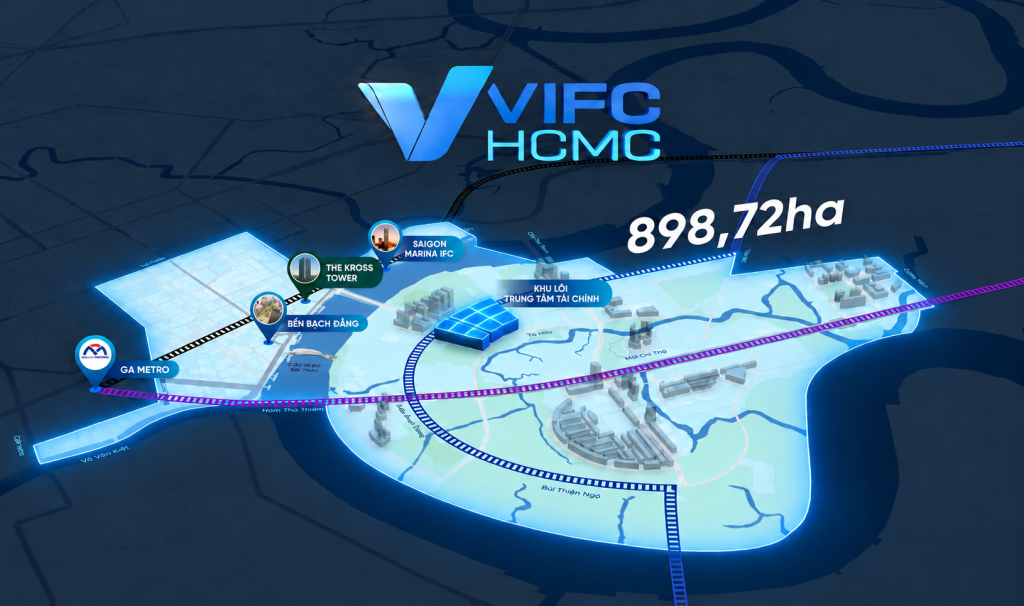
The city’s financial ecosystem is also developing. The Vietnam International Financial Centre in Ho Chi Minh City (VIFC-HCMC) entered its initial operational phase in February 2026, adding another dimension to the city’s role within Vietnam’s developing international financial ecosystem.
For financial services, technology, professional services and other specialised functions, this broader ecosystem can be relevant to GCC site selection in Ho Chi Minh City.
Connectivity is another consideration.
A GCC workforce can span thousands of employees commuting from different parts of the metropolitan area. Regional executives, clients and business partners may also need convenient access to the workplace.
The Kross is positioned approximately 50 metres from Ba Son Metro Station and 50 metres from Ba Son Bridge, connecting the workplace to Metro Line 1 and the road network toward Thu Thiem.
The building is also approximately 500 metres from Bach Dang Waterbus Wharf and benefits from its position within central District 1.
For a GCC office in Ho Chi Minh City, this multimodal accessibility can be evaluated as part of the wider workplace strategy: how easily can employees, clients and regional stakeholders reach the building from different parts of the city?
What Should Site Selectors Compare Across HCMC, Singapore and Hong Kong?
There is no universal location for every GCC.
Singapore and Hong Kong have established roles as international business and financial centres. Ho Chi Minh City represents a different operating proposition, with its own combination of talent availability, operating costs, domestic market scale, technology capabilities and developing corporate ecosystem.
For a company evaluating GCC Ho Chi Minh City against other regional markets, a useful comparison should look beyond headline office rent.
| Site Selection Dimension | What to Evaluate |
|---|---|
| Talent | Availability by function, seniority and technical discipline |
| Operating Cost | Labour, occupancy, fit-out and ongoing building costs |
| Office Supply | Grade A availability, floorplate sizes and expansion options |
| Connectivity | Public transport, road access, airport connectivity and commuting patterns |
| Business Ecosystem | Financial services, technology, professional services and corporate networks |
| Infrastructure | Power, telecommunications, building systems and security |
| ESG | Green certifications, energy performance and workplace wellbeing |
| Scalability | Ability to expand within the building, district or wider market |
| Workplace Experience | Amenities, environment, hospitality and employee accessibility |
The weighting of each factor depends on the GCC’s function.
A financial-services centre may prioritise proximity to financial institutions and professional services. A technology GCC may place greater emphasis on specialist talent, infrastructure and scalable floorplates. A regional operations centre may place greater weight on accessibility, workplace density and operating efficiency.
This is why GCC site selection in Ho Chi Minh City should move from market-level analysis to building-level due diligence.
What Does a 1,000–20,000 sqm GCC Need From Its Office?
GCC office requirements can vary substantially depending on headcount, workplace density, hybrid-working policy and the functions being located in the centre.
A 1,000 sqm workplace and a multi-floor regional capability hub have very different planning requirements.
At larger scales, floorplate efficiency becomes particularly important.
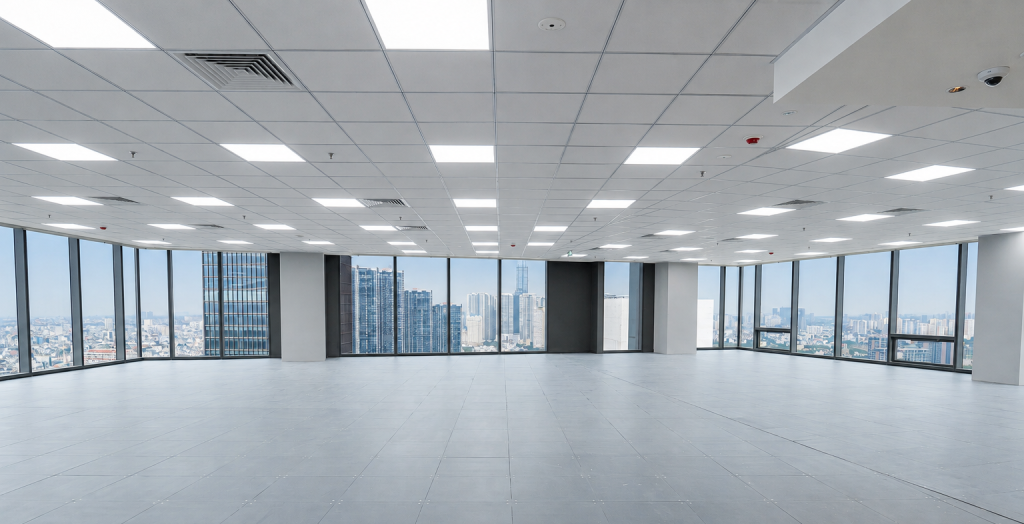
Efficient floorplates can simplify departmental zoning, collaboration planning, meeting spaces and future expansion. Conversely, inefficient cores, structural columns or limited infrastructure flexibility can reduce the usable potential of a workplace.
For companies assessing GCC office space in Ho Chi Minh City, technical infrastructure should also be part of the evaluation.
Key considerations include:
- Telecommunications and data infrastructure
- Raised access flooring
- HVAC and indoor environmental performance
- Power resilience
- Building Management Systems
- Vertical transportation
- Access control and security
- Fire and life-safety systems
- Energy management
- Sustainability and wellness standards
These considerations become increasingly important as a GCC takes on more technology-intensive or mission-critical functions.
ESG and employee experience should also be considered. For multinational occupiers, green-building credentials, indoor environmental quality, access to public transport and workplace wellbeing can form part of broader corporate real estate requirements.
The question therefore becomes:
What type of office building can support the GCC not only at launch, but throughout its next stage of growth?
From GCC Location Strategy to Workplace Strategy
Shortlisting a city is only the beginning of the real estate decision.
The next step is determining whether a specific building can translate the GCC’s operating model into an efficient workplace.
At The Kross, typical office floorplates range from approximately 994 to 1,053 square metres. The building also provides a 50 mm raised technical floor and 2.75-metre ceiling height across the office environment.
These specifications can be tested directly against a GCC workplace strategy.
For example:
- How many workstations can the floorplate accommodate?
- Where should collaboration zones sit?
- How should meeting and client-facing areas be positioned?
- Can different business functions occupy separate zones or floors?
- How much space should be reserved for future expansion?
- How can technology infrastructure be distributed efficiently?
- Can the workplace scale without requiring a complete relocation?
For a GCC in Ho Chi Minh City, these questions can be more useful than simply comparing advertised rental rates.
The floorplate becomes a strategic planning tool.
Why The Kross Can Support GCC Workplace Requirements

Located at 3A–3B Ton Duc Thang Street in District 1, The Kross combines a central corporate location with substantial office floorplates and multimodal connectivity.
For companies evaluating GCC Ho Chi Minh City requirements, several characteristics are particularly relevant.
Scalable Floorplates
Typical floorplates of approximately 994–1,053 sqm provide flexibility for different workplace configurations, from individual business functions to larger multi-floor operations.
Infrastructure-Ready Workplace
A 50 mm raised technical floor supports the distribution of power and data infrastructure and provides greater flexibility for future workplace modifications.
Vertical Connectivity
The building is served by 14 SkyRise® elevators with the Compass® 360 Destination Management System, supporting employee and visitor movement across the building.
Workplace and ESG Considerations
The Kross is designed around international sustainability and wellbeing benchmarks, including LEED Gold and WELL certification positioning, alongside building systems and amenities designed to support occupant experience.
For a GCC, these characteristics should not be evaluated as isolated amenities. They form part of the broader question of whether the building can support people, technology, operations and future growth.
From GCC Site Selection to the Right Floorplate
A successful GCC Ho Chi Minh City strategy connects three decisions.
First, where can the company access the right ecosystem?
This includes talent, clients, partners, professional services and the wider business environment.
Second, how can employees and stakeholders reach the workplace?
Transport connectivity, accessibility and the relationship between the office and the wider metropolitan area all become relevant.
Third, can the building support the organisation’s operating model?
That means evaluating floorplate efficiency, infrastructure, workplace planning, sustainability, security, vertical transportation and expansion potential.
Ho Chi Minh City provides a growing platform for companies evaluating regional capabilities. For organisations considering a GCC in Ho Chi Minh City, the decision should ultimately move beyond the city itself and into the specifics of the workplace.
The most useful site-selection process therefore follows a clear progression:
Market → City → District → Building → Floorplate
The Kross brings these considerations together through its central District 1 location, proximity to Ba Son Metro Station and Ba Son Bridge, substantial office floorplates and infrastructure designed for modern corporate occupiers.
For companies evaluating GCC office space in Ho Chi Minh City, the next step is to understand how the available space can translate into an actual workplace strategy.
Explore The Kross Floor Plans
Discover the available floorplate options and assess how your GCC workplace could be configured at The Kross.
Related Reading
Continue exploring the VIFC & Corporate Expansion series: