Understanding VIFC-HCMC tax incentives is essential for any company evaluating Ho Chi Minh City and Da Nang under Vietnam’s new VIFC framework. For companies weighing VIFC-HCMC tax incentives against an office location, the practical question is not simply whether an incentive exists, but whether the company’s proposed activity, investment structure and operating model satisfy the applicable conditions.
This guide summarises the principal policy themes relevant to corporate decision-makers, including corporate income tax, personal income tax, regulatory sandboxes and administrative procedures. It is intended as a business overview, not tax or legal advice. Companies should confirm eligibility and implementation requirements with qualified advisers and the relevant authorities before making an investment decision.
What Resolution 222/2025/QH15 Establishes
Resolution 222/2025/QH15 provides the legal framework for the Vietnam International Financial Centre. It was adopted on 27 June 2025 and took effect on 1 September 2025.
The resolution establishes the concept of a geographically defined international financial centre with a financial and supporting-services ecosystem. It also provides special mechanisms covering membership, investment, dispute resolution, taxation and other areas relevant to participating organisations.
The important point for businesses is that the framework is activity- and eligibility-based. Being located in Ho Chi Minh City does not, by itself, mean that a company automatically receives every VIFC incentive. Corporate teams should therefore distinguish between the overall policy environment and the specific benefits available to an eligible project or member.
VIFC-HCMC Tax Incentives: Corporate Income Tax
Article 19 of Resolution 222 sets out different corporate income tax treatments for new investment projects arising within the international financial centre.
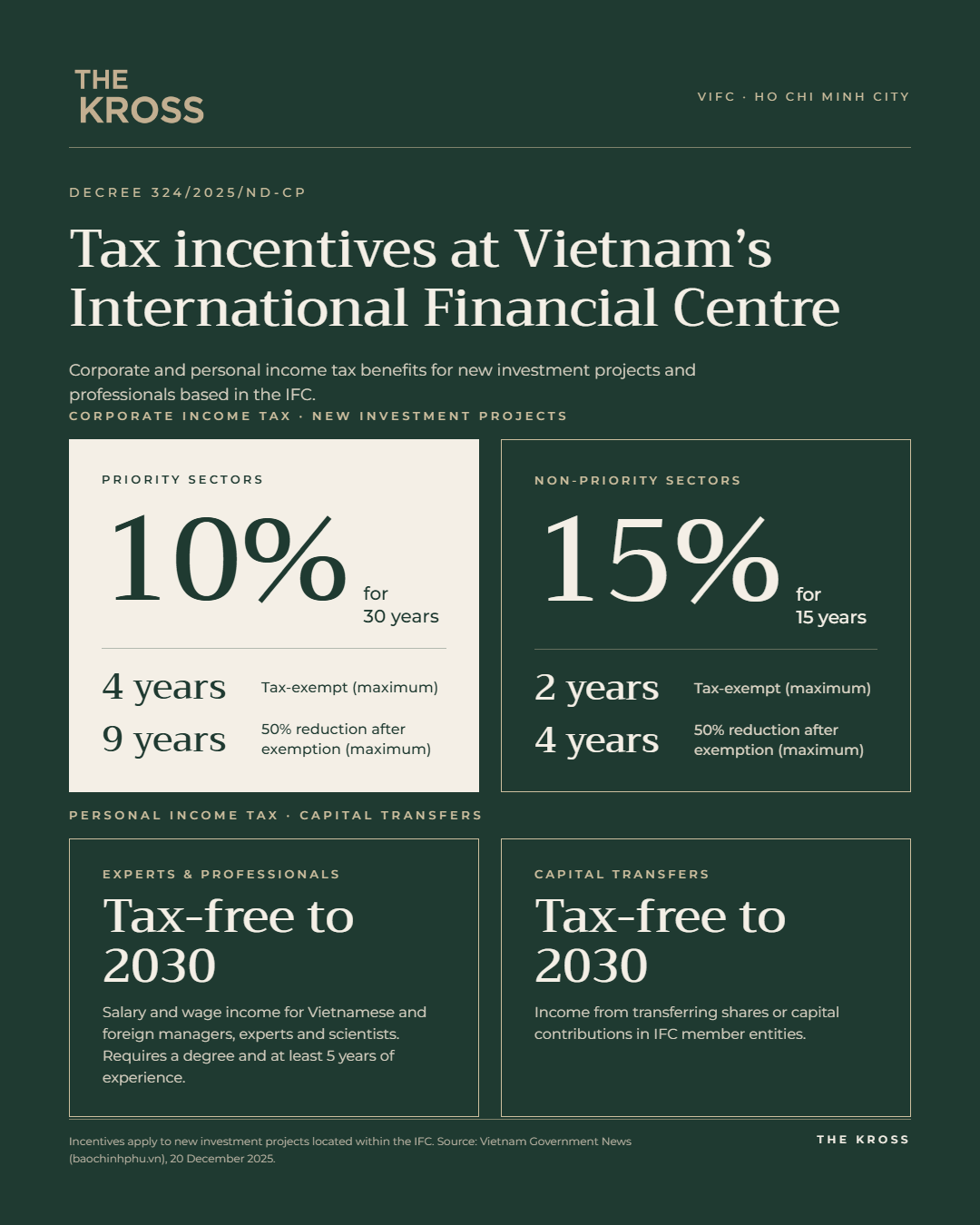
For income from a new investment project in an industry prioritised for development within the centre, the resolution provides a 10% corporate income tax rate for 30 years, together with an exemption for up to four years and a 50% reduction in payable tax for up to the following nine years, subject to the applicable conditions.
For income from a new investment project that is not within the priority industries, the resolution provides a 15% corporate income tax rate for 15 years, with an exemption for up to two years and a 50% reduction for up to the following four years, again subject to the legal conditions.
These are not blanket office-location benefits. The treatment applies to qualifying investment income and must be assessed against the project’s status, industry and other requirements. The implementing financial-policy rules are set out further in Decree 324/2025/NĐ-CP.
Personal Income Tax, Capital and Other Incentives
The VIFC framework also includes personal income tax incentives intended to support the attraction of specialised human capital. Resolution 222 provides an exemption from personal income tax on salary and wage income earned from work at the international financial centre, through the end of 2030, for qualifying managers, experts, scientists and highly qualified professionals, including Vietnamese and foreign individuals.
The resolution also provides an exemption through the end of 2030 for certain individual income arising from transfers of shares, capital contributions and contribution rights in a member organisation, subject to the applicable conditions.
For companies, these provisions are relevant to workforce planning because compensation, specialist recruitment and executive mobility can form part of the location decision. However, the detailed criteria and implementation rules should be checked before these incentives are reflected in financial models or employment packages.
Regulatory Sandboxes: What They Mean for Financial Innovation
A regulatory sandbox is designed to give qualifying innovative products or business models a controlled environment in which they can be tested under regulatory oversight. For financial and technology companies, this can be particularly relevant where new products do not fit neatly into established operating models.
The VIFC framework identifies financial technology and digital-asset organisations among the potential participants in the ecosystem, while the broader policy framework is designed to support innovation in financial services.
For an occupier, the real estate implication is indirect but important. Fintech, financial infrastructure and innovation businesses often need a workplace that supports technical teams, secure operations, client meetings and collaboration across disciplines. As these companies grow, their office requirements can move beyond conventional financial-services space.
Licensing & Administrative Procedures
The VIFC model is intended to create a more integrated operating environment for qualifying participants. The framework establishes dedicated operating and supervisory functions, while implementation has introduced mechanisms intended to simplify coordination between the centre and relevant authorities.
Companies should be careful with headline claims about licensing speed. There is no universal guarantee that every business will receive approval within a fixed number of days. The applicable procedure depends on the activity, legal form, documentation and relevant authority.
For corporate teams, the practical approach is to map the entire establishment process: eligibility, registration or recognition as a member, sector-specific approvals, tax registration, labour and immigration requirements, and ongoing compliance. The VIFC environment may streamline parts of that process, but the exact route should be confirmed for each business.
What This Means for Companies Choosing an HCMC Office
Policy can influence where a company wants to operate, but real estate determines how that operation works every day.
Once a company has identified a VIFC-related activity or strategic reason to establish an HCMC presence, its site-selection process should still evaluate access to talent, clients and professional services, public transport, airport connectivity, building quality, technical infrastructure, ESG requirements and the ability to expand.
This is why the office should be considered as part of the operating model rather than as a separate procurement exercise. A location that supports the company’s regulatory and commercial strategy should also provide a workplace capable of supporting the people and systems that deliver that strategy.
In short, VIFC-HCMC tax incentives create a new set of considerations for financial and related businesses evaluating Ho Chi Minh City. The precise value of the incentives depends on the company’s activity and eligibility, while the broader business case still depends on talent, market access, infrastructure and workplace quality.
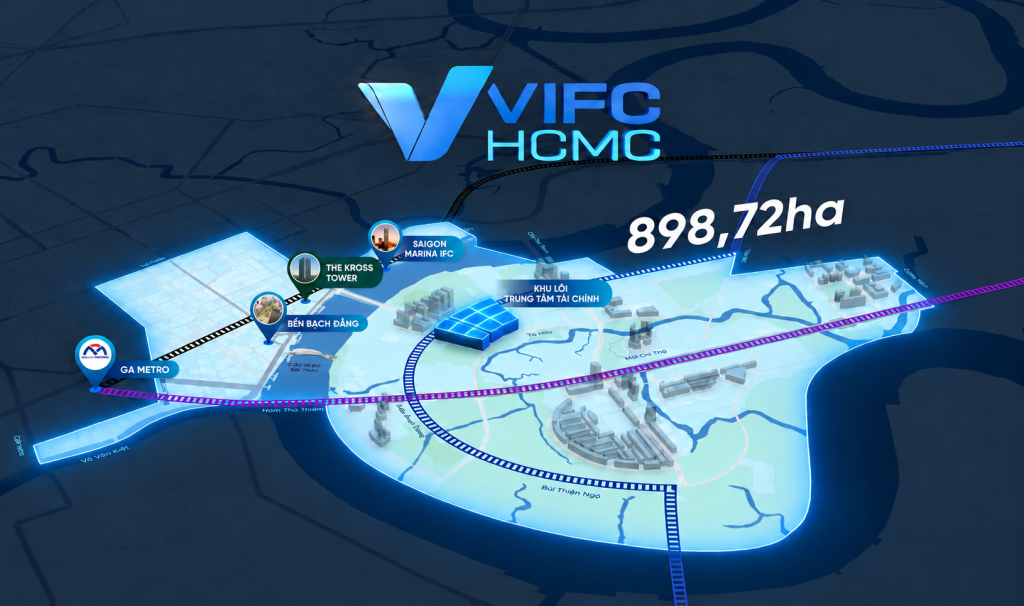
For companies progressing from market assessment to site selection, The Kross offers a central District 1 location with direct access to Ba Son Metro Station, Ba Son Bridge and the wider CBD.
Explore VIFC Leasing Opportunities at The Kross
Related Reading
Continue exploring the VIFC & Corporate Expansion series: The Definitive Guide to HCMC’s VIFC & Corporate Expansion, Why Multinational GCCs Are Expanding in Ho Chi Minh City, and LEED Gold & WELL: What ESG Standards Mean for MNC Occupiers.